
Avalara Pricing: Figuring Out Costs Based on Your Business
Avalara pricing is available only if you get a custom quote. While the lack of price transparency makes estimating pricing challenging, online reviews indicate that Avalara's services are costly and that the platform can be difficult to manage.



Avalara manages tax compliance, but doesn't publish prices online for most of its services. The company indicates that "many" products use volume-based pricing models, but doesn't disclose a specific fee structure.
However, Avalara users have shared details about costs. Based on hundreds of online reviews, many companies pay between $4,000 and $75,000 annually. Mid-market ecommerce and SaaS companies should expect to pay between $8,000 and $20,000 per year.
Costs for Avalara vary based on transaction volume, the number of tax jurisdictions you must register and file in, necessary integrations, and which compliance tasks Avalara takes on.
This guide explains the details of Avalara's pricing so you can estimate how much you'd pay and decide if it’s right for you.
The trusted solution for U.S. sales tax, VAT, and GST compliance, used by 3,500+ global businesses.
What real customers report Avalara pricing to be
Because Avalara is not transparent about price online, reading online reviews from existing customers is the best way to estimate costs without connecting to sales
Vendr, a SaaS and procurement platform that collects transaction data to offer market pricing insight, estimates that the median buyer pays $19,143 per year for Avalara. These estimates are based on over 400 purchases. Vendr also reports:
- Low-end pricing for Avalara at $4,122
- High-end pricing at $77,947 per year
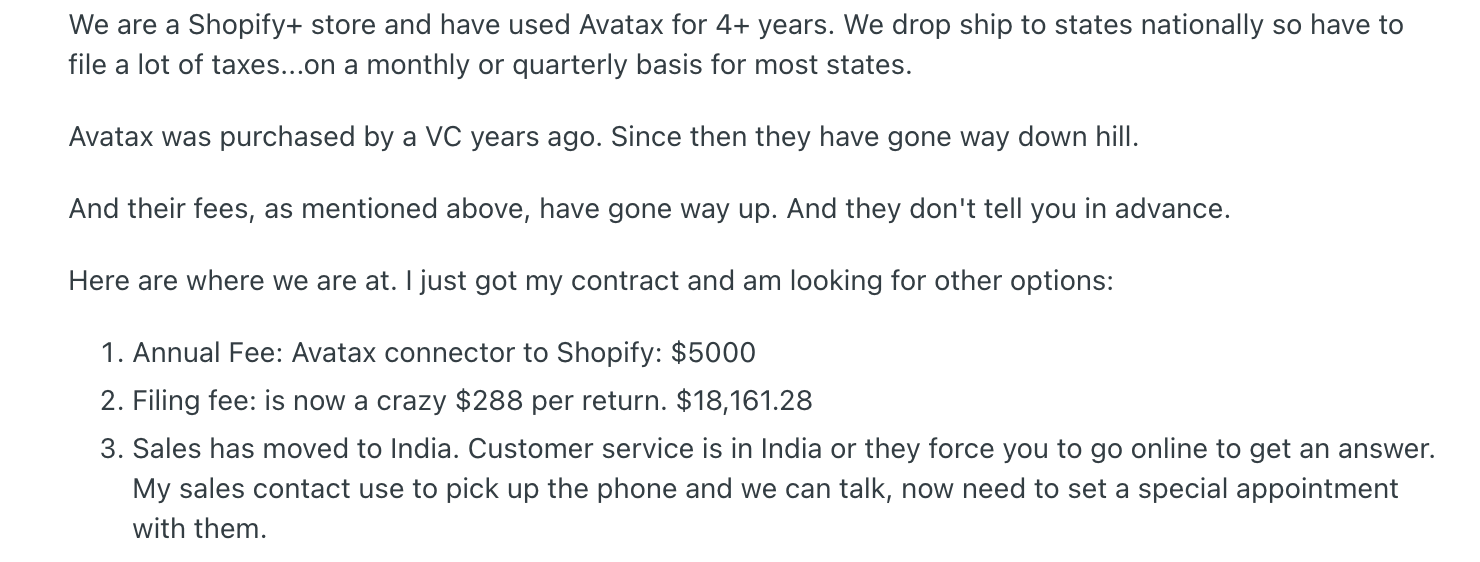
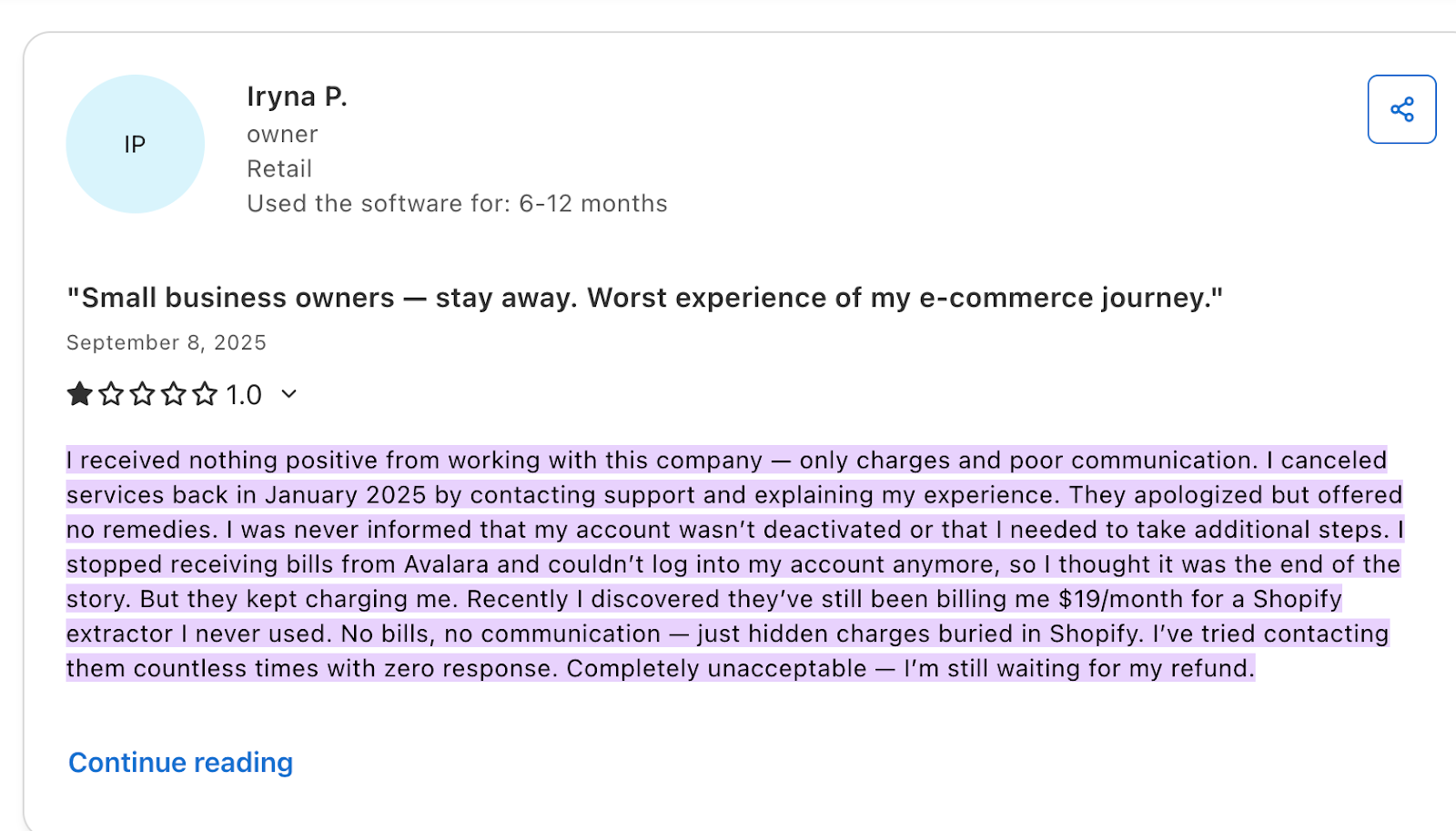
Many customers have also shared details on pricing, including frequent complaints about unexpected fees:
- A TrustRadius reviewer stated, "We were initially quoted under $1000 for the year for this service. I have now been charged upwards of $6,000 in a 12 month period. Mind you, we file returns for one state, and our business has less than 3,500 transactions per year."
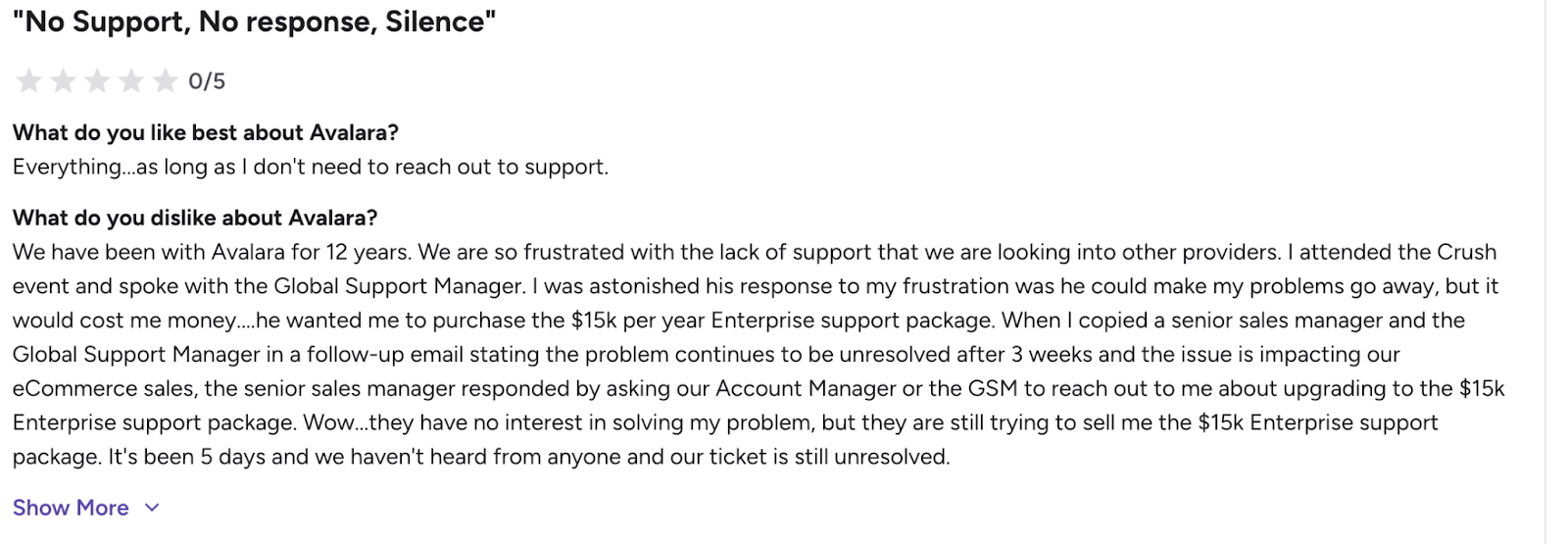
- A G2 reviewer commented, "We have been with Avalara for 12 years. We are so frustrated with the lack of support that we are looking into other providers. I…spoke with the Global Support Manager. I was astonished his response to my frustration was he could make my problems go away, but it would cost me money....he wanted me to purchase the $15k per year Enterprise support package."
- Another G2 reviewer said, "This is a very expensive sales tax solution. If you file in most states it is almost as expensive as hiring an employee to do the work."
- A Reddit user posted in 2024 about their dismay at Avalara's high prices, indicating, "The pricing we’ve been quoted is $7.4k/year for 15,000 transactions. This seems pretty expensive… The fee for filing is separate. This quote is solely for establishing a strong integration between Shopify and Avalara."
- Another Reddit user explained problems getting refunded after overcharges "Avoid at all costs! My experience with them has been nothing short of a nightmare. Support is unresponsive—my account manager takes at least a week to reply, and when I reach out for help, I just get redirected elsewhere. On top of that, I’ve been double-billed, and no one seems to know how to issue a refund."
Another reviewer highlighted numerous examples of Avalara encouraging their company to incur unnecessary costs:
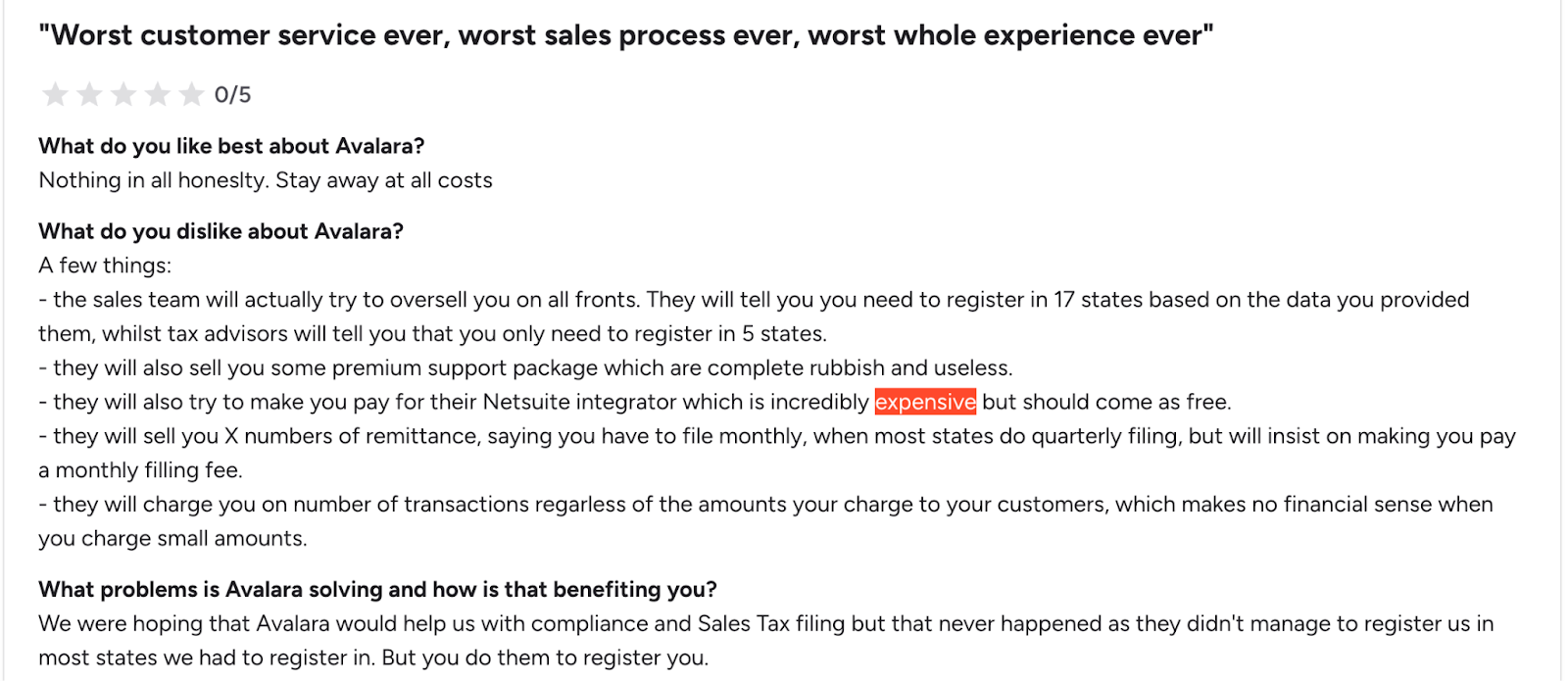
These comments suggest it may be difficult to fully evaluate Avalara's pricing, even after getting a quote, because there are so many reported instances of upcharges, overcharges, and unexpected fees.
To understand why Avarala's pricing is so complex, it's helpful to learn about how its model works.
How Avalara pricing works
Avalara pricing is complicated because you don't just pay a single monthly subscription fee. Avalara offers multiple products on its modular platform, and most businesses must purchase several to ensure full compliance with all tax requirements.
Avalara's core products include:
- AvaTax: AvaTax calculates tax at the time of sale or purchase. It integrates with existing systems to calculate taxes due based on product type and local tax laws.
- Avalara Returns: Avalara Returns prepares and files sales tax returns automatically so you can submit returns on the required schedule. Avalara also remits payments on your behalf to local departments of revenue.
- Exemption Certificate Management: Avalara Exemption Certificate Management (ECM) collects exemption certificates from exempt buyers, validates and stores certificates, and tracks renewals. Tax exemptions are also applied in real-time thanks to integrations with e-commerce and ERP systems.
- Avalara Registrations: Avalara's Sales Tax Risk Assessment allows you to determine where you've established nexus and become obligated to register. Avalara will also register for you. While prices for most services are undisclosed, licensing guides start at $119, and sales tax registration fees total $403 per location.
- VAT Returns & Reporting: Avalara can register you for VAT/GST in each jurisdiction where you establish nexus.
Most companies need multiple Avalara products to be fully compliant with tax rules. For example, SaaS and ecommerce companies would at a minimum need AvaTax and Avalara Returns to collect the correct amount of tax and file and remit payments to the state.
Since these are separate, unbundled products, fees add up quickly, especially as Avalara prices increase based on volume, so you will pay more based on:
- Products and services purchased
- Number of integrations with business applications
- Number of sales or jurisdictions where tax is collected
Ultimately, each company must negotiate with Avalara's sales team to set prices for most services, and you cannot get even a ballpark on your pricing without a call to the sales team.
Unfortunately, while this modular structure is a strength for enterprise businesses hoping to pick and choose services based on existing systems, it's a source of frustration for smaller companies that don't always know what help they need and prefer affordable bundled solutions.
AvaTax pricing: the most popular product
AvaTax is Avalara's core product, tackling the task at the heart of compliance: calculating and collecting the correct sales tax at checkout. Avalara charges based on transaction volume, and it's the first cost you'll need to calculate when estimating Avalara's total price.
AvaTax offers a tiered subscription model based on transaction volume, with users reporting volume bands that include:
- 0 to 500 transactions per month
- 501 to 2,500 per month
- 2,501 to 10,000 per month
- 10,000+ (Custom enterprise pricing required).
One Reddit user reported that Avalara quoted them
- $25,000 for 100,000 transactions
- $30,000 for 150,000 transactions
- $48,000 for 400,000 transactions
Avalara also charges overage fees when monthly volumes exceed contracted limits. Because those fees are higher than the base rates, spikes in traffic or seasonal surges can result in billing surprises.

Unfortunately, estimating transaction volume is challenging because the definition of transaction varies based on your contract with Avalara. As a result, your actual number of transactions with Avalara may differ from your expected usage.
Transactions can be added manually or created automatically through integrations and may include any sale, purchase, return, or inventory transfer. Depending on your contract with Avalara, transactions may include:
- A completed order
- Each line within a completed order
- Address validation API calls
- Tax calculation requests, even if no sale is completed
- Voided, canceled, or failed transactions
- Non-taxable sales
To estimate transaction volume accurately, explicitly ask your Avalara sales representative:
- Does each order line count separately?
- Do address validation API calls count?
- Do voided or failed orders count?
Avalara Returns pricing: filing and remittance
Once you collect sales tax, you also must file tax returns and remit payment. You'll need a separate Avalara product for that: Avalara Returns.
When Avalara files your returns, it charges per state. Users report filing fees totaling $42 to $65 per state, plus an activation fee. For a company filing monthly in 10 states, that's $650 in fees alone just for this service.
Your filing frequency affects costs, so request that Avalara base its pricing on whether you must file monthly, quarterly, or annually. Filing schedules are determined by the state based on transaction volume.
These fees are for filing only, and don't include initial registration costs.
Avalara Registration pricing
When you establish a physical or economic nexus in any state, you become obligated to register, then collect, file, and remit taxes. Physical nexus refers to having a local presence in the state, while economic nexus is based on the number of transactions or sales volume.
You only need to register one for each state, but failure to register when required leaves you vulnerable to audits and penalties. Avalara will register for you, but there's an added fee.
Avalara's published registration cost is $403 per location. While this is a one-time fee, companies that expand into new states incur it again. A fast-growing company entering 10 new states could owe Avalara $4,030 just for registration alone.
While companies that wish to avoid these fees can register directly with state revenue departments at no charge, this is burdensome and time-consuming. For those registering in just a few states, it's feasible, but fast-growing companies may struggle to keep up.
Avalara alternatives like Accounly charge far less for these services. Accounly charges just $150 per registration—less than half of Avalara's advertised rate—and Accounly doesn't require you to purchase a filing subscription or sales tax calculation services to get help registering.

How to estimate your Avalara cost
To estimate pricing with Avalara without having to speak to a sales representative, use these estimated costs of each Avalara product to get a clearer idea of the total annual fees you would pay. You can:
- Determine your estimated transaction volume. Remember, the definition of "transaction" is often very broad.
- Add up the total number of states where you're likely to establish nexus and will be required to register
- Determine if your likely filing cadence is monthly, quarterly, or annually based on your transaction volume
- Evaluate how many integrations you're likely to need
- Determine if you will need exemption certificates and how many you are likely to need
- Determine if you plan to sell internationally
Then use the estimated pricing above to calculate total costs based on:
Integration cost + number of transactions + number of state registrations + filing fees for return.
Companies with large transaction volumes, registration requirements across multiple states, monthly filing requirements, and numerous required integrations will pay the most.
The table below shows likely fees based on business size and transaction volume—but remember, if you have specialized needs or want premium support, you can expect to pay much more.
| Business type | Estimated annual Avalara cost |
|---|---|
| Small ecommerce (under 5K transactions/year, 5 states) | $5,000–$8,000 |
| Mid-market ecommerce (15K–50K transactions/year, 10–20 states) | $10,000–$20,000 |
| Enterprise (100K+ transactions/year, multi-country) | $30,000–$70,000+ |
First-year costs for implementation and initial registrations typically run $5,000 to $10,000 higher than ongoing costs, but prices for basic services can and often do increase year-over-year.
Once you've obtained an Avalara quote, remember it is negotiable. If you have quotes from competing providers, you can use them as leverage to try to get Avalara to lower costs. Alternatively, you can use your Avalara quote to shop with other vendors.
Is Avalara worth it?
Avalara is expensive because it provides essential tax support to enterprises and companies with complex tax situations.
If you operate in multiple countries, have an internal tax ops team, and need the flexibility of modular services, or rely heavily on ERPs that Avalara has certified integrations with, Avalara may be a fit.
However, e-commerce or SaaS companies with under $10 million in revenue may find Avalara's pricing is prohibitive and its benefits too limited to justify paying such high prices.
Companies with straightforward tax situations, including nexus in a limited number of states, may also prefer alternatives.
Businesses that prefer transparent pricing without a long sales process, or who prefer bundled pricing, modern platforms, and responsive customer service teams, may also wish to look elsewhere, as the time spent managing issues with Avalara adds to the effective costs.
How Accounly’s pricing compares to Avalara
Companies looking for full tax compliance without the complexity and high price tag of Avalara have other options. Accounly is one of the top Avalara alternatives worth considering. Accounly offers:
- Free nexus monitoring so you can track exposure across states at no cost and with no commitment.
- Pay-per-use pricing, with fees totaling $75 per filing and $150 per registration. These costs are a fraction of Avalara's, and there is no monthly subscription or long-term commitment required
- End-to-end solutions for the full compliance workflow, including nexus monitoring, auto registrations, automatic filing and remittance, and exemption certificate management. You even get a virtual mailbox so Accounly can handle state notices on your behalf
- The Accounly Guarantee: if their error causes a missed filing, they cover resulting penalties and interest, so you're not exposed to the risk that Avalara users report around surprise errors and unexpected bills
If you're ready to get compliant with sales tax without committing to a six-figure enterprise platform, book a demo with Accounly to see how we can help.
The trusted solution for U.S. sales tax, VAT, and GST compliance, used by 3,500+ global businesses.
Comparing Avalara pricing to alternatives
Want to see other alternatives to Avalara? Check out some of our comparison articles to help you find your fit: